A Scene List will reveal the treasure hidden within your big baggy draft.
Unless you’re a meticulous planner and stick to your plan as you write, you’re going to find the Scene List an invaluable tool when it comes to nailing your second draft.
When I first began writing I was firmly in the “Pantser – Writing by the seat of your pants” club. This resulted in a couple of super long, rambling and unfocused drafts of about 130 000 words each, necessitating a severe pruning, back to around 40 000 in both cases. ARGH! But where to start?! When you’re staring at a pile of words and pages that big, like an overgrown mock-orange bush in your garden, you need a powerful pruning tool.

Enter the wonderful writer and writing educator, Kim Wilkins, who introduced me to the scene list which has been a much-loved tool for over a decade now.
Once I started screenwriting, writing from the premise down to the scene list and filling in the gaps from there, I could see the benefit of doing some planning first, but I still love the freedom and pure creative joy of writing just to see where the story takes me. So these days I do a little vague planning at the start of a project but allow myself some leeway and fun tangents as well. I guess you’d call me a “Planster” now – half planner, half pantster.

Here’s what you need to know to get a SCENE LIST working for you, whether you’re writing a memoir, novel or screenplay.
It’s not rocket science so don’t get scared – if I can do it, you certainly can too.
You can do this with software like Scrivener or Final Draft but I’m a hard copy girl, my brain works better when I have something I can hold in my hand and shuffle around. I love my cut and paste both ways— with scissors and glue, and the ease of computer deletions and insertions. So find the way that works best for you and:
SCENE LIST BASICS
- WRITE A LONG LIST OF EVERY SCENE IN YOUR PROJECT – don’t scream. Yes it’s long and a little tedious, but the benefits will be obvious. I do mine on index cards – one scene per card, but you can do it as a straight list, hard copy or on screen. Do it in columns if doing a straight list.
- NAME EACH SCENE
- WHAT IS THE MAIN ACTION?
- WHAT CHARACTERS?
- WHOSE POV? If only one POV that’s easy J
- DOES THIS SCENE MOVE US TOWARDS HOPE OR FEAR? See Suspense = Hope + Fear if you don’t know what this means.
- WHAT KIND OF SCENE/SECTION IS IT? – Reflective sections in memoir? Character reflections/ action/comedy/sad etc
- WHERE IS IT SET?
So you’d have seven columns for this version
SCENE NAME. ACTION. CHARACTERS. POV. H/F. TYPE. SETTING
Add whatever other details feel relevant to you and your story. EG if you’re interweaving POV characters you could colour code their POV sections to make sure you have an even balance. Or length of the scene as well – number of pages etc.
This process may take a while. You may end up with hundreds of scenes. GOOD! If you’re struggling to figure out what would be a scene, then that’s a sure sign you’re telling more than showing, and a signal to actually WRITE IN SCENES. See How to Write a Scene if you’re having trouble.

That’s us waving good bye to scenes that no longer serve the story 🙂
Once you’re done look for these key things
- REPETITION – of scenes, settings, ideas, plot points (eg I’ve already realised that in my latest Work In Progress I’ve done a couple of scenes with my protagonist finding her son asleep drunk in the lounge – one has to go!) Like me, you’ll have to pick the best of the repeated scenes, or echoes, to keep, and either change or delete the other/s. Make sure you haven’t shown us a scene and then done another scene with characters just rehashing the action without adding anything new or moving the plot forward.
- NOT ENOUGH ACTION – have you got a whole lot of scenes with people thinking? Is there any forward movement in your story? THIS COULD BE A GAP YOU NEED TO FILL, or you need to think more about what is at stake in your story.
- TOO MUCH FEAR/ TOO MUCH HOPE – have you got as much movement as possible between hope and fear? If you’ve got a long patch of only fear fear fear, consider moving scenes around to bring balance or creating a scene of hope between all the hard stuff. Or the other way around.
- WHAT DO YOU NEED TO ADD? Are there gaps in the story? Is someone’s POV missing from most of it? Does a character of importance suddenly appear halfway through the second act? Have you forgotten to add any reflection?
- WHAT CAN GO? This is when you call back in that inner critic and make them work for you. What scenes are there just because you really liked the feel of it, or the memory attached?
These are the cut rules. First make a separate file called “Good bits for later” where you can put your offcuts. Then,
CUT if your scene:
- Repeats without adding anything.
- Is off track and confusing (no matter how pretty)
- Is too much backstory – slowing everything down – keep snippets to thread through
- Shows a character doing something that doesn’t fit with who they are – unless it’s a potent moment of change, of course.
- Is rambling, feels like padding. LESS LESS LESS IS MORE.
- Is a subplot you forgot about halfway through after you realised it wasn’t necessary.
- Doesn’t move the plot forward or show us something new about the character.
- Doesn’t feel right anymore – trust your gut.

No more clambering through pages and pages – now you can just refer to your list!
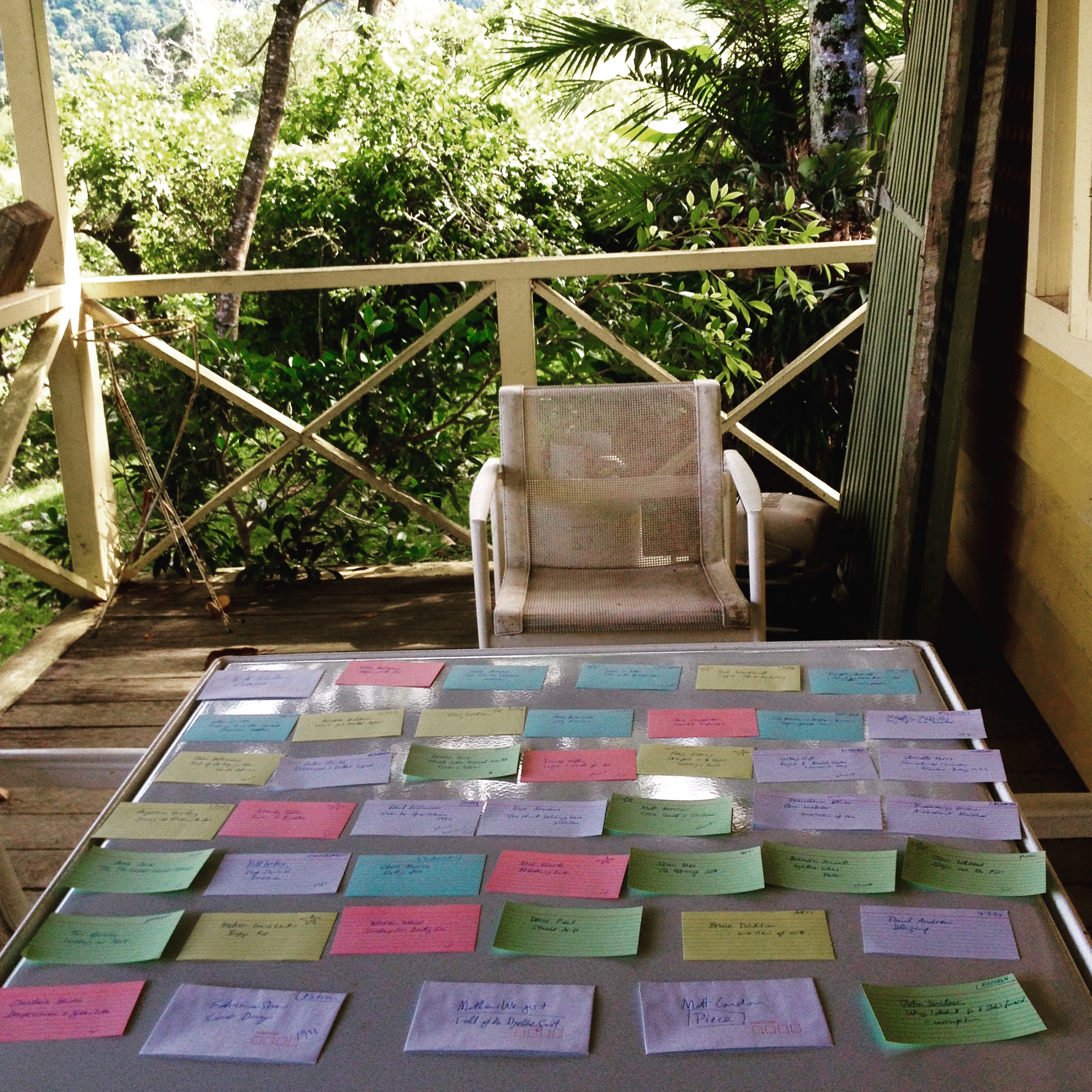
The scene list identifies plot holes and needed character development by showing us a template of our whole book in a more manageable form. I like to lay my cards out on a big table (or the floor) to get a good overview, then I can shuffle my physical cards around, remove them, add in new scene ideas where they fit, and “see” my story laid out in full, identify any patterns and fill any holes as I go.
You can do all sorts of colour coding and add special ratings, EG: for Thrill Seekers I had a “Bleakness scale”. Yep, I needed to add a lot of light to balance things out.

Any questions, just ask in the comments or drop me a line.
I’m offering a free online writing workshop in December for subscribers to my newsletter so remember to sign up by the end of November to get the link! SUBSCRIBE HERE.
I hope you’ll find the scene list as useful as I have. It takes work, but once you see how powerfully it reveals the strengths and flaws of your MS, you’ll know it was worth it!
Lots of love
Edwina xx
 Edwina Shaw
Pingback: 5 EASY TIPS FOR STRONGER WRITING | Edwina Shaw