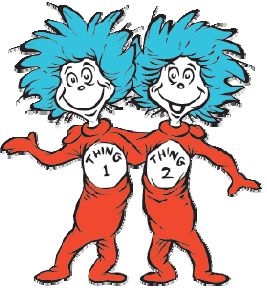
Thing 1 and Thing 2 Short Story Method

638af1c495c03b15897035f30e18d85e

Got a great story but it’s just not selling? Or you’ve got a great idea but the story just isn’t working somehow? Need a way to think about short stories so you can generate ideas quickly? Well, here’s my THING 1 and THING 2 STORY METHOD.

You can use this for larger pieces of writing too but it works best for short things.

fullsizeoutput_609

Thing 1

THING 1

Think of an incident or a turning point in your own life, or the life of someone else you know, or someone you just made up 🙂 This could be anything from a traffic accident to the birth of a child to discovering you have cancer. ANYTHING! Remember it only has to be a thing.

In my story “Mrs Sunshine” I thought of a family breaking down, a young mother on the verge of leaving her partner and children – that was my incident.

For my story “Last Days on the 15th Floor” in Bjelke Blues – it was the last few days of ex-Premier Joh Bjelke-Petersen’s rule when it is rumoured that he locked himself in his office and refused to leave.

In “Something No One Else Can See” my Thing 1 was the climbing number of suicides among farmers here in Australia.

Thought of something you could try? Good!

631260_1

THING 2

Thing 2 is important. Thing 2 is what gives your story another layer of meaning and depth. Thing 2 can be anything, any – thing at all 🙂 Somehow whatever you choose your brain will find a way to link it to the themes in your story. Thing 2 will help to amplify the hidden truths in your story without you even having to try that hard.

For “Mrs Sunshine” – Thing 2 was a Sunshine Family set of dolls I was given for Christmas as a child and came to mean a whole lot more than just toys. Mrs Sunshine became a symbol for the impossibly perfect ideal of motherhood.

In “Last Days on the 15th Floor” – Thing 2 was Joh’s Vietnamese cleaner whose father had been governor of her hometown. Her perspective gave the story a whole new understanding.

In “Something No One Else Can See” – two sisters coping with the loss of their mother, building fairy houses and believing in magic, helped to bring lightness to what could have been a very dark tale.

So, what is your Thing 2? Nothing immediately coming to mind? Look around you and pick an object. Any object. Put that into your story and see if the magic of imagination doesn’t somehow build that simple object into a meaningful part of your narrative.

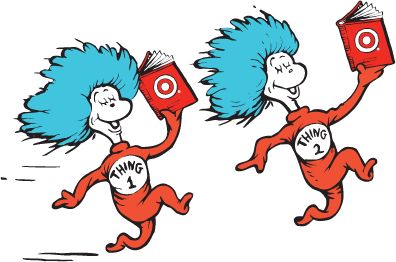
Flick open a book and stab at a word. That could just be the key to adding another layer to your story. Have a close look at some short stories – can you find the Thing 1 and Thing 2?
unnamed

But why stop there just because Dr Seuss did? Chuck in a Thing 3 if you feel like it!

THING 3 – an abstract noun  like LOVE or HATE or REVENGE or FAITH or REGRET or FORGIVENESS.

Put your incident, your character or object and the noun together and what have you got?

A STORY – that’s what!

This post is making me go all Dr Seuss so I’d better stop now 🙂

I hope you get lots of great stories from Thing1 and Thing 2 (and 3).

Let me know how you go, and if you discover any THINGS in stories you read.

GOOD LUCK!

HAPPY WRITING!

Lots of love

Edwina xx

One-Time
Monthly
Yearly

If you’ve found my advice useful please help support jobbing writer.
Make a one-time donation, buy me a cuppa and help keep me afloat 🙂

Make a monthly donation

Make a yearly donation

Choose an amount

A$5.00
A$15.00
A$100.00
A$5.00
A$15.00
A$100.00
A$5.00
A$15.00
A$100.00

Or enter a custom amount

A$

Your contribution is greatly appreciated.

Your contribution is appreciated.

Your contribution is appreciated.

DonateDonate monthlyDonate yearly

5 WAYS TO BUILD NARRATIVE DRIVE IN MEMOIR

tower-of-books-1

John Gardner once said, “Structure is the primary concern of the writer.” The more I write and edit other people’s writing, the more I agree with him. It’s not the story itself but how the writer chooses to arrange story elements that keeps the reader turning pages.32533._SY475_

This is easier when writing fiction than when dealing with the real-life constraints of memoir, but here are a few ideas to help you keep your memoir readers up at night in a page turning frenzy.

Before we start there are a couple of issues you need to consider. First of all

  1. What are you writing?

If you’re intention is to record your entire life history then you’re writing an autobiography, not a memoir. What’s the difference? A memoir is a focused selection of life events around a particular theme or time in your life.

  1. Who is your audience?

Are you writing just for family and friends, or people who shared these experiences with you? If so, then you can really write whatever you like and they’ll still read it.

http://hdl.loc.gov/loc.pnp/ppmsca.50484

However, if you believe your story has a wider appeal, that you have a story of interest to the general reading public then you’re going to have to work a whole lot harder at building narrative drive to hook them in and keep them reading right till the end. If you’re not a famous sports star or a glamorous movie queen, then selling your memoir to a publisher is going to be tricky. You need to make sure you have a compelling narrative that grabs them right from the start. But how?

Reading by Lamplight by James Whistler

Reading by Lamplight by James Whistler

5 WAYS TO BUILD NARRATIVE DRIVE IN MEMOIR

  1. Write down all your key plot points.

An easy way of thinking about this is to call them Heart Clutching Moments as Elizabeth Sims does in her Writers Digest Article

Think of the moments in your memoir that have most emotional impact – the parts where your hand goes to your heart. Key emotional turning points – remember to include some happy moments as well as those of drama or trauma. Write down a list of as many of these as you can think of.  Put big circles around the most important and a star next to the most emotional, most moving, heartbreaking moment. That is your climax.fullsizeoutput_5b2

  1. Find your central quest or question?

Delve deep into what your story is really about. Ask yourself, “What is this story about?” Then again, “What is this story really about?” Ask yourself those two questions seven times. Famous non-fiction writing teacher Robin Hemley developed this method for finding the heart of your story.heart with eye

Once you have your answer then formulate a question or quest. In memoir it might be something like this “Will Mary ever find the daughter she gave up for adoption in 1965?” or “Will innocent Bob survive his time in jail?” Or “Will Sarah find a cure for her mysterious illness and be well again?”

You get the idea. What is your central question?

  1. Find your Hope and Fear around this question.

In order to keep the reader highly engaged in your story, every scene and chapter needs to move them between hoping that YES – your central quest/ion will have a happy ending (that’s your hope) and NO! – the very worst will happen (that’s your fear).

654-08231766

For example

HOPE: Mary will find her adopted daughter who will want to see her and they will lovingly reunite.

FEAR: Mary won’t ever be able to find her daughter no matter how hard she tries or how close she gets. OR Mary will find her daughter who won’t want to have anything to do with her.

HOPE: Bob will study and be freed from his wrongful imprisonment and go on to be a lawyer advocating for those still in jail.

FEAR: Bob will be brutalised in jail. All his appeals will fail, and he will die, sad and alone, in the electric chair.

Oh dear – poor Bob!

electric chair


What is your Hope and Fear?

  1. What is your HOOK?

s-l400

Your hook is what sets up your question and the connected hope and fear right at the start of your memoir. Look at your list of Heart Clutching Moments and find one which will be best to draw your reader into your story. It doesn’t have to be what chronologically happened first. The power of writing is that you get to play around with the order of events to create most suspense and impact. It doesn’t have to be the whole event, just a snippet of it. Then once you’ve set up your question and what is at stake you can go back and fill in the background.

For example

Mary gives birth to a precious baby girl and gets to hold her, but only for a few minutes. Then she is spirited away and a weeping Mary signs away her rights as mother.

Bob is eating his last meal on death row, the priest beside him giving comfort. He starts down the long hallway in chains.

  1. Arrange your key plot points

415DVmwzY2L._AC_SY400_

Look at that HCM list and arrange them after your hook. You can list them chronologically but make sure there is movement between your hope and fear in each one. Build to your most impactful moment as your climax. And make sure that you have some kind of satisfying conclusion – even if it’s sad.

For example

Mary gives birth etc

Mary at the graveside of her husband who she never told about her secret child – now she is free to look for her.

Mary tells her son about her search. Son says, “She won’t want to see you.”

Mary finds old papers and begins search.

Mary finds orphanage but records were lost.

Mary finds alternate clues – her daughter has been searching for her

Mary gets sick – she may die before she finds her daughter – search intensifies.

Mary finds an address – in the same state!

Mary’s son kicks up stink – why are you doing this? It’s too stressful! You’re sick!

Mary makes a tentative phone call – gets her daughter’s husband

Mary’s illness worsens.

Mary’s daughter arrives on her doorstep and they reunite tearfully and joyfully.

Mary’s son reacts badly.

Mary’s daughter is a doctor and heals Mary and all family is happy and harmonious!

images

Now real life isn’t usually so orderly, nor does it have neat closed off endings, but for the purpose of your memoir you’re going to have to find a satisfying point to stop where the main quest or question has been resolved.

These exercises can be done after you’ve already completed a draft or even better, before you start the big job of writing it. If you can write to a structure that is already moving between hope and fear, then your job is halfway done.

Of course all of this is applicable to fiction writing as well – just easier to do because you can invent events and keep that movement between hope and fear with a flick of your pen.

GOOD LUCK!

writing on retreat!

If you’d like to learn more about memoir writing or just make a start on telling some of your life stories, then my next retreat in Highfields west of Brisbane is now open for enrolments. Come and join a like-minded group of women and get writing! See here for all the details.

What is your memoir’s central question? What is the hope and fear? Need help working it out? Ask away!

Lots of love

Edwina xx