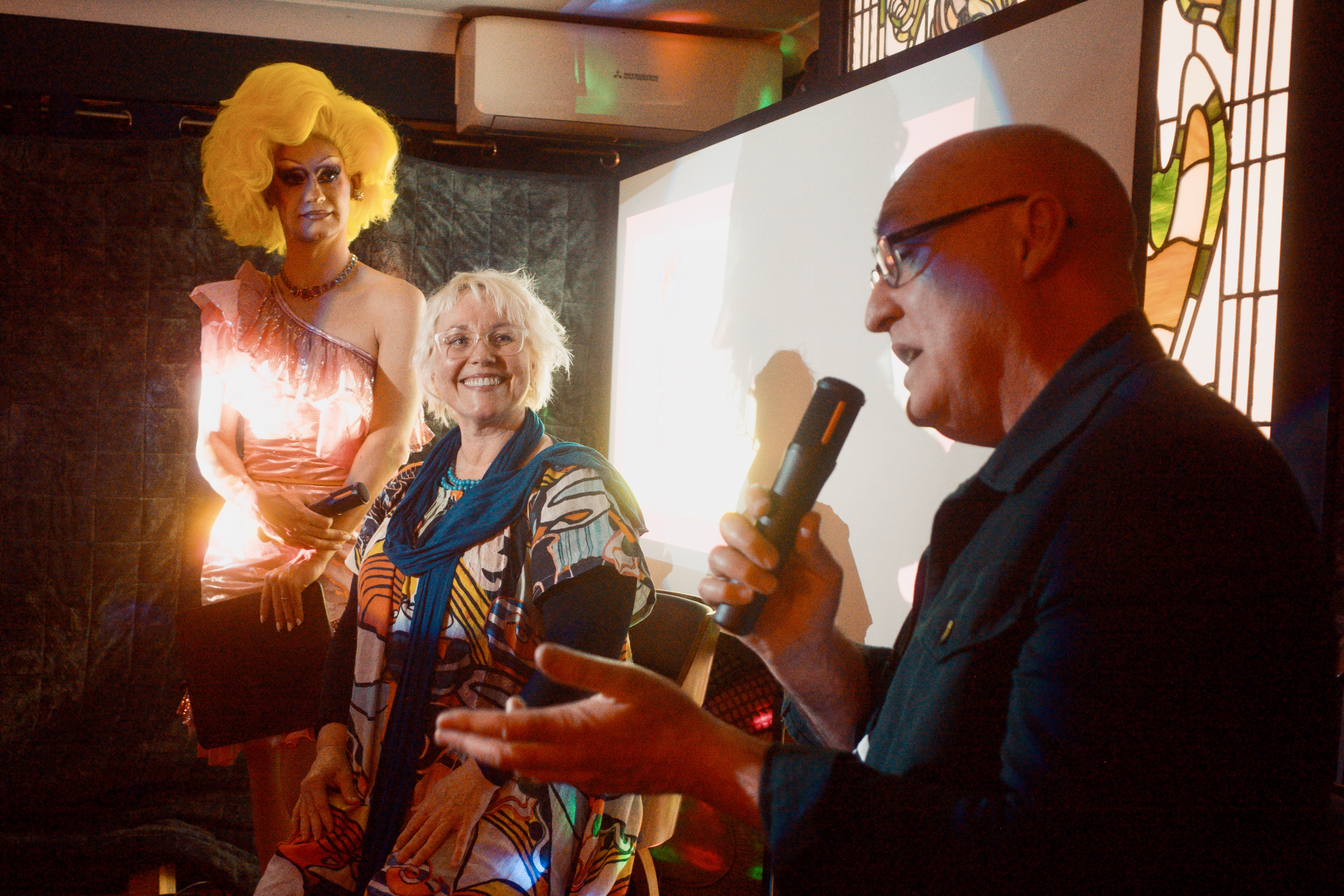
At the Queersland launch with our hostess Evalyn Eatdith and my co-editor Rod Goodbun
Woohoo! You’ve written your book, it’s been published, now all you have to do is sit back and rake in the big bucks! Right?
Wrong.
Marketing and promoting your book are a job in themselves – actually a few people’s jobs. All writers would be well advised to do some kind of marketing course because even if you publish with a major publisher who LOVES your book, they’re only going to put their marketing team behind it for a maximum of a month. Yes, that’s right, a month. Then they move on to their next big release.

Sally holds a copy of Queersland open to her story!
We authors are the ones who are most passionate about these stories we have worked on for years, so it’s up to us to ensure the people who would love to read it, find out it exists. Read more MARKETING TIPS here. And here is some advice on DISTRIBUTION for those publishing with a small press with limited distribution, or independent publishers.
Marketing your book starts with giving your book baby a beautiful birth into the world with a book launch. I love book launches – they’re the best party ever, because it’s celebrating so much hard work done in solitude, hidden within our computer files, unloved and unseen.
And then THE LAUNCH – finally the world can see you haven’t gone crazy, you weren’t just eating chips in front of the telly all that time, you were writing. Writing a wonderful book, a book you can now hold in your hands and share with others. Congratulations.

A successful launch sells a lot of books and gets your publication off to a good start. A book launch is not just a party celebrating all your hard work, but also a powerful marketing tool. A successful launch creates buzz around your book and may even get you on your local bookstore’s best seller list, which is a thrill, but more importantly, brings your work to the attention of more readers.
So how to create a successful launch?
Here are my…
SIX EASY STEPS TO A SUCCESSFUL BOOK LAUNCH!
- Book a venue – depending on your purpose this can be a bookstore or somewhere else. We launched Queersland at a local gay bar so we could fit in more people, as we knew with 35 contributors we’d have a big crowd.
When you launch at an independent venue, if you are self-published, you get to keep all the profits from book sales, rather than 40% per copy going to the bookstore. My dear friend Gay Liddington launched her memoir Will I Ever Be Who I Am at her local community centre because of the work they do with DV support.
BUT if you want to get your street cred as a writer up, then bite the bullet, pay the fee and launch at your nearest independent bookstore (or local equivalent).
Wherever you launch, unless you score a special deal or you launch at home, you’ll have to pay a fee for hiring the venue.

Nick Earls and the panel of readers at the Bjelke Blues launch in 2019.
2. Find someone to launch your book. The person who hosts your event should be able to help bring in a crowd and be experienced in hosting events like this, lively, engaging and intelligent. Ask your most famous writing friend or alternatively someone who is knowledgeable about your book’s topic or theme. I hosted Gay’s launch, and we also invited her ex-commanding officer from her time in the army to do the official launching. For Queersland our hostess was the fabulous Evalyn Eatdith, drag artist – the perfect host for a queer event.
Come up with a list of questions you’d like to be asked to help stimulate discussion. Make the conversation interesting and ensure it drives interest in the book. Organise the discussion and readings to engage the audience’s emotions. Make them laugh and make them cry.

Our hostess with the mostest at the Queersland launch, drag performer, Evalyn Eatdith
3. Invite other readers/Select good sections to read: If you’re launching an anthology featuring the work of many writers – like Queersland and Bjelke Blues, this is super easy. Pick a variety of readers to give an overview of the book and get them to stick to two minutes maximum. Two minutes (or shorter) is a good length for readings in these days of shortened attention spans.
If the book is only yours, I recommend interspersing short readings with an interview that illustrates your main themes and the narrative’s trajectory, without giving too much away.
If you’re shy, consider asking other writers you know to do short readings as well. That will give them a leg up, and also boost numbers as they’ll bring along friends and family to hear them read.
PRACTISE your readings. It’s all well and good until you start to read in front of a crowd – then the emotion hits. So practise until you know your well-chosen sections by heart. Stand tall, read loudly and with emotion. Vary the cadence of your voice and remember to look up at the audience sometimes. Slow down. When we’re nervous we tend to speed up. Don’t be afraid of emotional scenes – showing emotion will help sell books!


Our talented readers from the Queersland launch. Steve MinOn, Ollie Lanagan, Shane Rowlands, Odette Best and Stevie Velour.
4. Make the launch free or cheap. People who have had a free drink and an entertaining show are much more likely to buy a book. These days some established bookstores are charging quite a hefty entry fee for launches, without providing much in the way of snacks or beverages. I always pay the venue up front so my launch is free for punters, so they have more cash left to buy my book. That’s the aim, after all.
5. Make your launch a special event. Call on friends with talent – a local guitar player, your friend who sings, some interpretive dance perhaps, a video maker, any performance or music will help lift the atmosphere to party level. That’s what you want for a memorable launch. Music, images, fun and food. You can create a playlist of music that resonates with your book, show a slide show of related images, raffle off prizes, find ways to involve the audience and get them laughing (and/or crying).
Feed your readers too. For Bjelke Blues and Queersland I made a few cheese platters, and we provided a free drink with the entry fee. Gay baked enough delicious biscuits and cakes to feed a small army for her launch. Lubricate those impulse spending neurons with fun, food and a glass of wine.
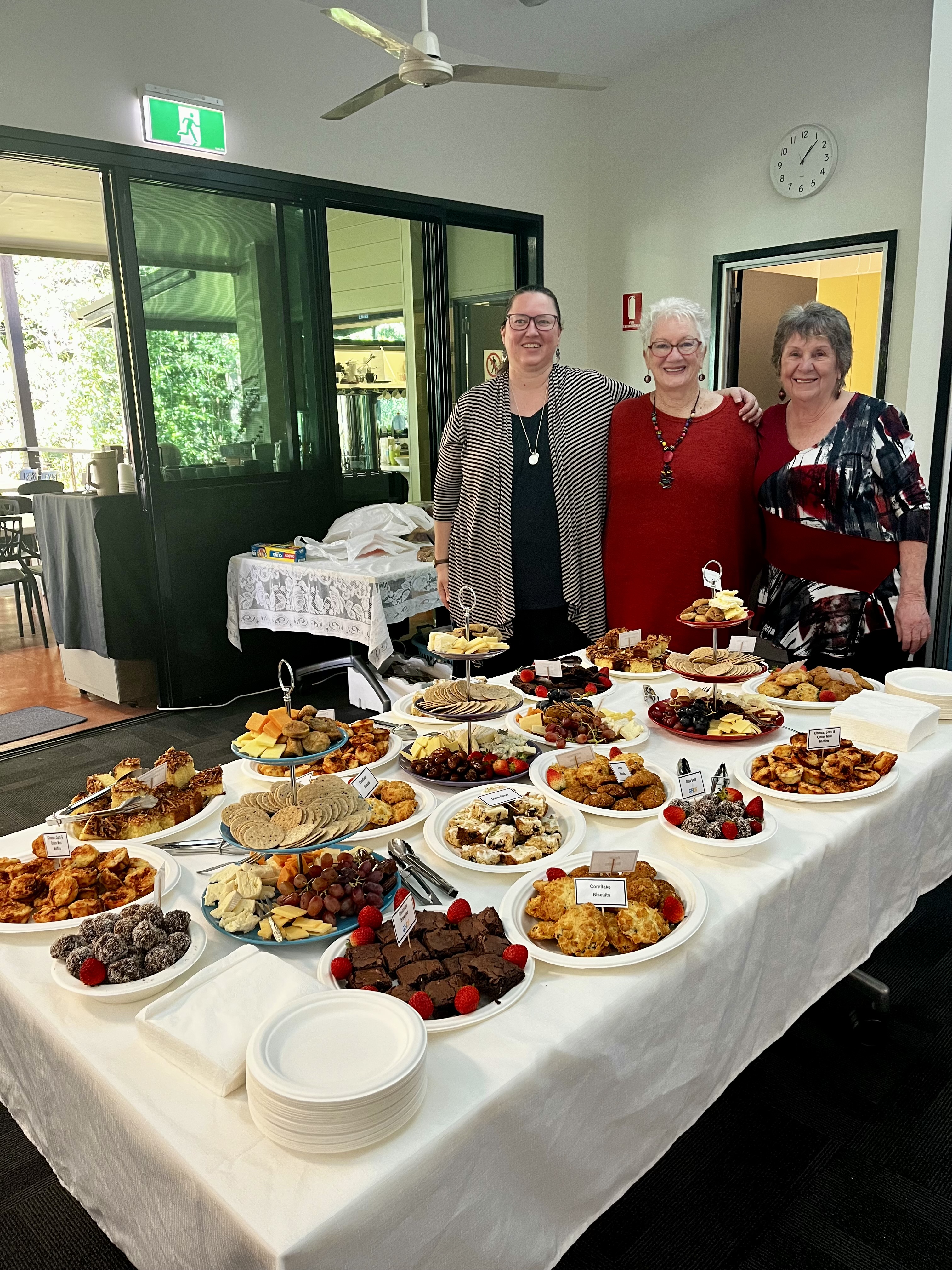
Gay, Kylie and Mary with Gay’s launch table packed with treats!
6. Tell everyone about it – EVERYONE! Make sure you spread the word about your book and the launch well in advance. Even if the launch is free, you can create an event on Facebook or on Eventbrite or some other online entity for people to register to attend. Email anyone who’s had input into your writing and invite them personally. Personal invitations go a lot further than a Facebook invitation.
As part of your marketing campaign join lots of groups attached to your topic/themes and let people know about your launch. If you’re holding your launch at a bookstore, they will also advertise the event, but don’t count on that filling your seats. Your friends and family will be the main attenders so get them to spread the word too. You can also advertise the event on community noticeboards and/or contact your local paper and let them know about it. Who knows, the local paper may even write an article about your book and launch. You never know your luck!

Edwina signs a copy of Queersland
Launches are crazy and nerve-wracking, with hordes of people and fun! The best part for me is signing copies of your book at the end. Wherever you hold your event, make sure you set up a signing table for yourself and enjoy meeting the readers who are going to love your book. Make each inscription as personal as you can – include the person’s name and something specific to them – even if only – Thanks for coming to the launch, or Lovely to meet you. That personal touch makes a difference.
You’ve done all the hard work, so enjoy celebrating this chapter of your book’s life. Let yourself shine a little. Remember to thank everyone and feel the reward of successful completion. WELL DONE!
I hope my hints and tips help you create a memorable launch. What ideas do you have to make your launch special? Let me know in the comments.
Lots of love,
Edwina xx



 Edwina Shaw